GitHub Plans: Seats, Hosts, and Qualifying Tiers
Choose your GitHub plan by mapping must-haves to qualifying tiers — seats, hosts, ingest, and add-ons — not homepage “from” tiles.
Quick answer
Choose a GitHub plan by mapping must-haves for source control and DevOps platform to a qualifying tier — seats, hosts, ingest, and add-ons included — not by comparing homepage “from” tiles. Confirm developer AI assistance (Free+) is on the package you will actually buy. Never invent list prices here — confirm seats, hosts, ingest, and quote terms on /pricing/github/.
- List day-one must-haves
- Map to a researched qualifying plan
- Price hosts / ingest / add-ons you will actually use
- Confirm trial or free proving ground
- Write the quote before you buy
GitHub packaging rules
- Tiles are the bottom layer — GitHub is often sold on seats, hosts, ingest, or quote packaging in our snapshot — treat homepage tiles as marketing, not a bill of materials. Confirm live packaging on the pricing page.
- Gates change the bill — Plan-gated in research: developer AI assistance (Free, Team, Enterprise).
- Free is a proving ground — Our snapshot records no trial length for GitHub — ask for an evaluation window in writing before you commit seats.
- Wrong cluster, wrong comparison — Do not compare GitHub (source control and DevOps platform) to GitHub Copilot (AI coding plugin) or Datadog on a single price tile.
GitHub qualifying configuration
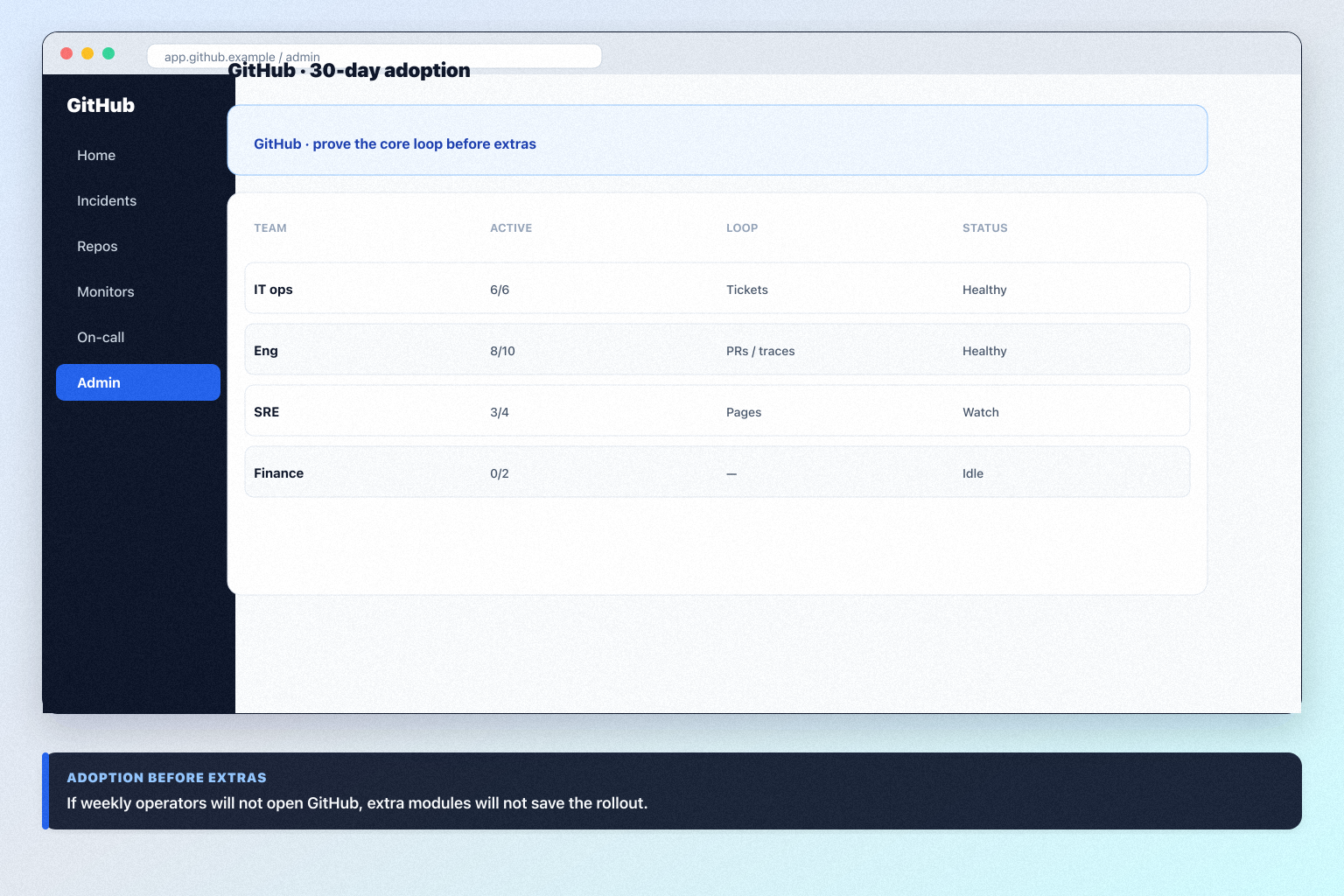
1. List must-haves, then qualify
Must-haves should match push a branch, open a PR, and merge with Actions green — Copilot is a different product. Research-supported features include log management, source control and repos, CI/CD and automation, and developer AI assistance. Worked example: Northline Engineering (two squads) drops a cheaper tile when the must-have workflow unlocks only on a higher hub.
2. Compare like for like
Never invent list prices here — confirm seats, hosts, ingest, and quote terms on /pricing/github/. Worked example: Northline Engineering (two squads) totals the qualifying configuration at their headcount — not the marketing starter tile — then asks for the quote in writing.
GitHub must vs nice
- Core job on entry plan
- Gated capabilities
- AI / extra modules
GitHub checklist
Bring these questions to every demo
Ask vendors to show the workflow live, not just describe it.
- 1List day-one must-havesFeatures that must ship without an unused enterprise tier.
- 2Map to a qualifying planUse researched plan names — not marketing starting tiles.
- 3Get the qualifying quote in writingSeats, hosts, add-ons, and implementation fees.
3. Map must-haves to plan names in writing
Feature gates researched on GitHub: developer AI assistance (Free, Team, Enterprise). Map each must-have to the plan that unlocks it.
Compare published tiers on the same headcount assumption.
Worked example: Software teams needing Git source control as the system of record screenshots the plan shown in demo and matches it to /pricing/github/.
4. Model seats, usage, and add-ons together
Build one sheet: seats, usage units, add-on SKUs, and overage triggers for GitHub. Compare totals — not entry tiles.
5. Get a written quote on the qualifying configuration
Ask GitHub for a quote that names plan, seats, usage band, and add-ons. Store it next to alternatives with the same assumptions.
Worked example: Software teams needing Git source control as the system of record files quotes in the same folder with identical date and headcount headers.
6. Map must-haves to plan names in writing
Feature gates researched on GitHub: developer AI assistance (Free, Team, Enterprise). Map each must-have to the plan that unlocks it.
Compare published tiers on the same headcount assumption.
Worked example: Software teams needing Git source control as the system of record screenshots the plan shown in demo and matches it to /pricing/github/.
7. Model seats, usage, and add-ons together
Build one sheet: seats, usage units, add-on SKUs, and overage triggers for GitHub. Compare totals — not entry tiles.
8. Get a written quote on the qualifying configuration
Ask GitHub for a quote that names plan, seats, usage band, and add-ons. Store it next to alternatives with the same assumptions.
Worked example: Software teams needing Git source control as the system of record files quotes in the same folder with identical date and headcount headers.
9. Map must-haves to plan names in writing
Feature gates researched on GitHub: developer AI assistance (Free, Team, Enterprise). Map each must-have to the plan that unlocks it.
Compare published tiers on the same headcount assumption.
Worked example: Software teams needing Git source control as the system of record screenshots the plan shown in demo and matches it to /pricing/github/.
10. Model seats, usage, and add-ons together
Build one sheet: seats, usage units, add-on SKUs, and overage triggers for GitHub. Compare totals — not entry tiles.
11. Get a written quote on the qualifying configuration
Ask GitHub for a quote that names plan, seats, usage band, and add-ons. Store it next to alternatives with the same assumptions.
Worked example: Software teams needing Git source control as the system of record files quotes in the same folder with identical date and headcount headers.
12. Before you sign with GitHub
Confirm the qualifying plan, non-admin proof, and integration owners in writing. Store quotes next to /pricing/github/ and the evaluation scorecard so finance can audit the same assumptions at renewal.
13. Write the decision memo
Name the job, the qualifying GitHub configuration, and what you are not buying yet. If stakeholders cannot explain why an alternative lost, the trial was not fair.
Frequently asked questions
Does a free GitHub plan count?
Our snapshot records no trial length for GitHub — ask for an evaluation window in writing before you commit seats.
Should we pay annually?
Only after the qualifying configuration is written. Annual discounts do not fix the wrong hub.
Was this article helpful?
Have more questions? Contact our support team.
SoftwareGlimpse Updates
Want clearer software shortlists? Get buying guides and comparisons by email.
Newsletter coming soon.