SoftwareGlimpse
AI Software

Emergent Implementation: 30/60/90 AI Rollout That Sticks

Plan a practical Emergent rollout — owners, core AI loop, training, and adoption checkpoints — so the product becomes how the team actually works.

By Lee M.Updated Aug 18, 20265 min readFact-checked

Quick answer

Roll out Emergent in gated phases: freeze 90-day outcomes for AI assistant for a specific job cluster, name an owner, configure the core loop, train the people who must update it weekly, then review adoption before adding automations or extra add-ons. Treat Emergent implementation as phases — not a feature dump in week one.

  • Freeze 90-day outcomes
  • Name an admin owner
  • Days 1–30: core loop only
  • Days 31–60: train weekly users
  • Days 61–90: adoption review, then extras

Emergent rollout media

Official setup walkthroughs and product surfaces that matter while you roll out Emergent — not a full product gallery.

Official Emergent setup walkthrough

Vendor tutorial for onboarding and configuration. It is not a SoftwareGlimpse rollout plan — use this guide for judgment.

This video is hosted on YouTube

This content is hosted by YouTube. The player loads only after you allow marketing cookies.

Official vendor tutorial

Emergent: The First AI Platform That Builds Production-Ready Apps

How Emergent presents the product in an official vendor video.

What this shows

  • Emergent product surfaces as shown in the official vendor video
  • UI/workflow layout marketed by the vendor
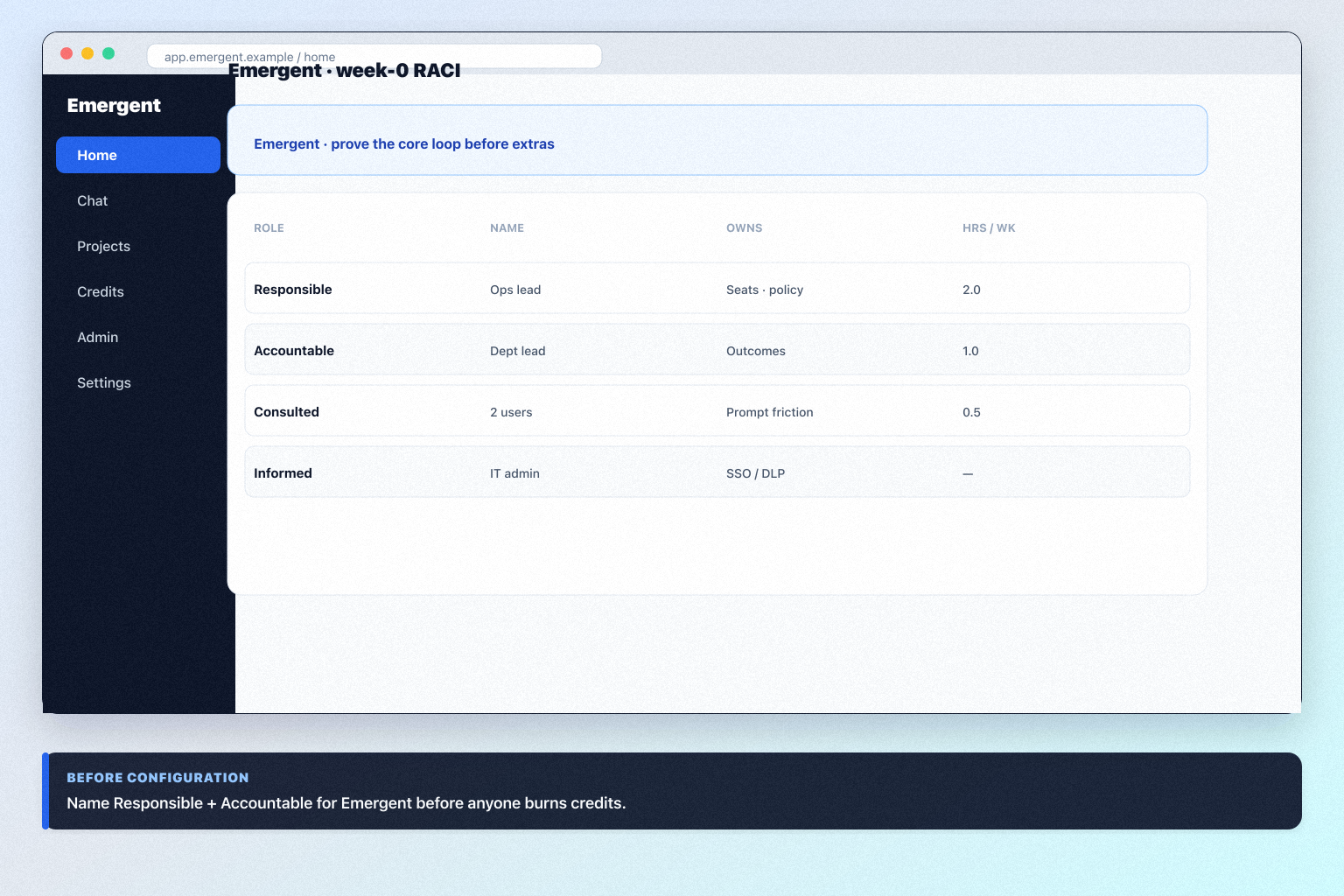
Full product screenshots and evidence live on the Emergent research page.

Emergent rollout rules

  • Job cluster first Emergent is AI assistant for a specific job cluster. Do not implement it as a different AI job cluster.
  • Adoption before add-ons If Harbor Ops will not open the product weekly, extra add-ons will not save the rollout.
  • Integrations are a phase Research names Zapier on the Emergent side — confirm the connectors your AI loop depends on.
  • AI is optional Research lists AI assistant, AI summaries, AI automation, and AI recommendations for Emergent.

Emergent 30/60/90

Emergent 30/60/90 rollout for AI assistant for a specific job cluster.
Treat Emergent implementation as gated phases — not a feature dump in week one.

1. Days 1–30: core loop only

Configure seats or credits for weekly users, one core workflow, and a data policy. Success looks like: complete one real job (prompt → output → share) a non-admin can repeat. Worked example: Harbor Ops (weekly AI users) delays optional extras until the core loop has a week of real use.

2. Days 31–60: train weekly users

Train the people who must update Emergent every week — not a one-time all-hands. Our snapshot records no trial length for Emergent, so Free is your proving ground. Worked example: Harbor Ops (weekly AI users) includes one sceptic user in training so adoption risk shows up before go-live speeches.

3. Days 61–90: adoption review

Check whether the core loop is actually used. Only then add automations, extra add-ons, or extra models. Worked example: Harbor Ops (weekly AI users) reviews shared prompts, credits used, or workspace adoption (whichever matches AI assistant for a specific job cluster) before expanding scope.

Emergent checklist

Bring these questions to every demo

Ask vendors to show the workflow live, not just describe it.

  • 1Freeze 90-day outcomesMust-haves for AI assistant for a specific job cluster before configuration sprawl.
  • 2Name an admin ownerFields, users, and hygiene need a responsible party.
  • 3Schedule adoption reviewCheck core-loop usage before adding automations.

4. Lock plan gates before phase two

Map must-have workflows to the Emergent plan that unlocks them — demos often run above the tier you can afford.

Worked example: Builders prototyping AI agents and micro-apps freezes must-haves on the qualifying tier before adding automations.

5. Measure adoption on the core loop only

Track weekly completion of the primary workflow — not logins alone. If Emergent is empty after 30 days, pause new modules and fix the ritual.

Worked example: Builders prototyping AI agents and micro-apps reviews completion rates before enabling AI add-ons.

6. Expand scope only after 90-day proof

AI surfaces on Emergent include AI assistant, AI summaries, and AI automation. Turn on AI only after the core loop works without it.

Add automations, secondary hubs, or advanced reporting only after the core loop survives a full quarter.

Worked example: Builders prototyping AI agents and micro-apps schedules a 90-day review before buying add-on seats.

7. Lock plan gates before phase two

Map must-have workflows to the Emergent plan that unlocks them — demos often run above the tier you can afford.

Worked example: Builders prototyping AI agents and micro-apps freezes must-haves on the qualifying tier before adding automations.

8. Measure adoption on the core loop only

Track weekly completion of the primary workflow — not logins alone. If Emergent is empty after 30 days, pause new modules and fix the ritual.

Worked example: Builders prototyping AI agents and micro-apps reviews completion rates before enabling AI add-ons.

9. Expand scope only after 90-day proof

AI surfaces on Emergent include AI assistant, AI summaries, and AI automation. Turn on AI only after the core loop works without it.

Add automations, secondary hubs, or advanced reporting only after the core loop survives a full quarter.

Worked example: Builders prototyping AI agents and micro-apps schedules a 90-day review before buying add-on seats.

10. Lock plan gates before phase two

Map must-have workflows to the Emergent plan that unlocks them — demos often run above the tier you can afford.

Worked example: Builders prototyping AI agents and micro-apps freezes must-haves on the qualifying tier before adding automations.

11. Measure adoption on the core loop only

Track weekly completion of the primary workflow — not logins alone. If Emergent is empty after 30 days, pause new modules and fix the ritual.

Worked example: Builders prototyping AI agents and micro-apps reviews completion rates before enabling AI add-ons.

12. Expand scope only after 90-day proof

AI surfaces on Emergent include AI assistant, AI summaries, and AI automation. Turn on AI only after the core loop works without it.

Add automations, secondary hubs, or advanced reporting only after the core loop survives a full quarter.

Worked example: Builders prototyping AI agents and micro-apps schedules a 90-day review before buying add-on seats.

Frequently asked questions

  • How long should rollout take?

    Ninety days is enough for most SMB/mid teams if you freeze the job and defer extras. Longer programmes help when change management is the risk.

  • What if we also need a different AI job?

    Buy the second job as a second product (or a later wave). Emergent should not be stretched into a different AI job cluster.

Was this article helpful?

Have more questions? Contact our support team.

SoftwareGlimpse Updates

Want clearer software shortlists? Get buying guides and comparisons by email.

Newsletter coming soon.