Ecwid Plans: Seats, Hubs, and Qualifying Tiers
Choose your Ecwid plan by mapping must-haves to qualifying tiers — seats, hubs, pools, and add-ons — not homepage “from” tiles.
Quick answer
Choose a Ecwid plan by listing day-one must-haves for embeddable SaaS storefront, mapping them to a qualifying tier — subscription, processing, apps, GMV, or quote packaging included — then proving the loop on that package before you buy. Confirm marketplace channels (Starter+) and dropshipping sourcing (Starter+) are on the package you will actually buy. Homepage “from” tiles are not a bill of materials. Never invent list prices here — confirm plans, processing, and quote terms on /pricing/ecwid/.
- List day-one must-haves
- Map to a researched qualifying plan
- Price processing, apps, and GMV you will actually use
- Prove the loop on the package you will buy
- Get the qualifying configuration in writing
- Never invent a spreadsheet total in this guide
Ecwid packaging rules
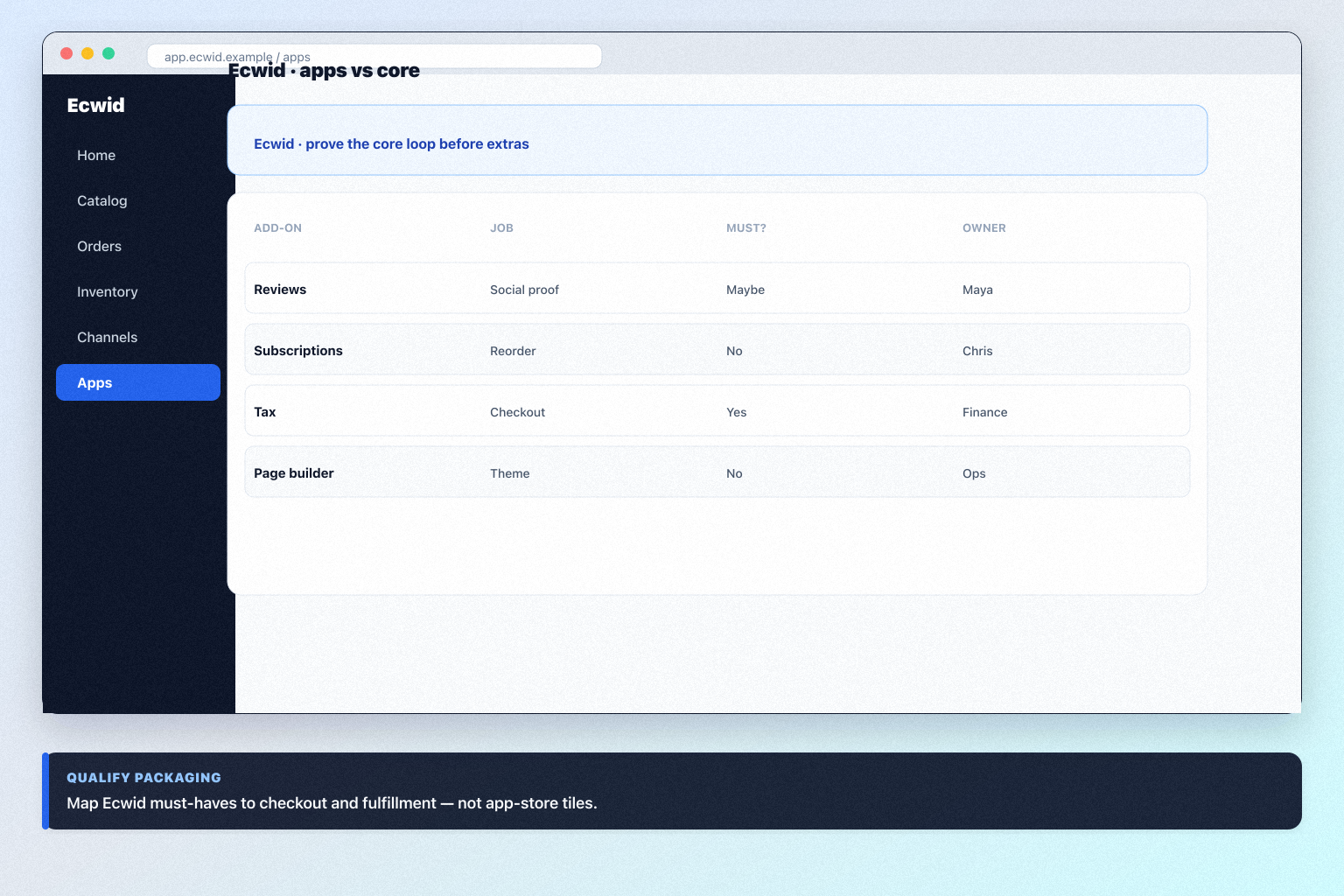
- Tiles are the bottom layer — Ecwid is often sold on subscriptions, processing, apps, or quote packaging in our snapshot — treat homepage tiles as marketing, not a bill of materials. Confirm live packaging on the pricing page.
- Gates change the bill — Plan-gated in research: marketplace channels (Starter, Venture, Business, Unlimited); dropshipping sourcing (Starter, Venture, Business, Unlimited).
- Prove on the package you will buy — Our snapshot records no trial length for Ecwid — ask for an evaluation window in writing before you commit to a plan.
- Job cluster first — Must-haves should match embed the store on an existing page, add a product on the plan you buy, and complete a test checkout. Do not pay for hubs that serve a full Shopify-class commerce OS or a dropshipping importer.
Ecwid plan path
Ecwid plan anatomy
What actually shapes a Ecwid bill
We do not invent list prices here. Use this anatomy, then confirm live numbers on the Ecwid pricing page.
- Seats61%
- Add-ons18%
- Implementation12%
- Training5%
- Other4%
Subscription / hub
The researched plan that unlocks checkout, imports, or sales channels — not the homepage starter tile.
Processing / GMV
Transaction fees, payment plans, and any GMV bands. Confirm whether the vendor’s processor is cheaper than yours.
Apps, modules, themes
Plan-gated in research: marketplace channels (Starter, Venture, Business, Unlimited); dropshipping sourcing (Starter, Venture, Business, Unlimited).
Hosting / implementation
Open-source and enterprise paths add hosting or integrator hours — get fees in writing; do not invent them.
AI / extras
Research lists AI assistant, AI summaries, AI automation, and AI recommendations for Ecwid. Research places AI assistance on Starter, Venture, Business, and Unlimited.
Who Ecwid packaging usually fits
- 01
Early catalog / one channel
Fits when embeddable SaaS storefront is the job and you can live without enterprise multi-storefront or composable programmes.
- One store or connected storefront
- Named merchandiser
- Payments you will actually use
- 02
Growing catalog / omnichannel
Fits when inventory, channels, or GMV gates matter and someone will admin the store weekly.
- Named store owner hours
- Must-haves mapped to a qualifying hub
- Stop shadow spreadsheets for stock
- 03
Quote-led / multi-store
Fits only if Ecwid is still embeddable SaaS storefront at that scale — not if you actually needed a full Shopify-class commerce OS or a dropshipping importer.
- Written qualifying configuration
- GMV / processing rules
- Adoption review before more apps
Ecwid must vs nice
- Core loop on the qualifying plan
- Payments / shipping / channels for day one
- online storefront, product catalog, checkout payments, and order management
- AI / extra apps
1. List day-one must-haves for this job cluster
Honest musts
Five jobs, all used weekly — catalog, checkout, and the channel you sell on.
Wishlist
Twelve musts including unused AI and marketplace apps — cut to five.
Wrong job
If musts describe a full Shopify-class commerce OS or a dropshipping importer, this product’s packaging will not save you.
Must-haves should match embed the store on an existing page, add a product on the plan you buy, and complete a test checkout. Research-supported features include online storefront, product catalog, checkout payments, and order management. 1. Write five things the store must do in week one.
- Mark each must vs nice.
- Drop anything that is actually a full Shopify-class commerce OS or a dropshipping importer. Worked example: Harbor Studio (existing site adding commerce) drops a cheaper tile when the must-have workflow unlocks only on a higher hub.
2. Map must-haves to a researched qualifying plan
Mapped
Every must-have has a researched plan name.
Tile shopping
You compared “from” prices across vendors — restart from must-haves.
Quote-only
If there is no public matrix, get the configuration in writing before you call it cheap.
Ecwid is often sold on subscriptions, processing, apps, or quote packaging in our snapshot — treat homepage tiles as marketing, not a bill of materials. Confirm live packaging on the pricing page. 1. For each must-have, write the lowest researched Ecwid plan that includes it. Plan-gated in research: marketplace channels (Starter, Venture, Business, Unlimited); dropshipping sourcing (Starter, Venture, Business, Unlimited).
- The highest plan on that list is the qualifying tier — not the homepage starter tile.
- Check processing, GMV bands, and extra storefronts separately. Never invent list prices here — confirm plans, processing, and quote terms on /pricing/ecwid/. Worked example: Harbor Studio (existing site adding commerce) discovers checkout, imports, or a sales channel force a higher hub than the tile they screenshotted, so they re-qualify before a trial.
3. Prove the loop on the package you will buy
Honest trial
Loop works on the hub you will pay for.
Inflated trial
Ask the vendor which package the tenant is on, in writing.
Free-plan trap
Free is a proving ground only if must-haves actually live there.
Our snapshot records no trial length for Ecwid — ask for an evaluation window in writing before you commit to a plan. 1. Run a non-admin can add a SKU and a buyer can check out without leaving the host site on the qualifying hub — not a demo enterprise workspace.
- Confirm processing and app behaviour if they change the bill.
- Write the configuration: plan, processing, apps, billing term. Worked example: Harbor Studio (existing site adding commerce) fails the gate when the trial ran Plus features they will not purchase. They restart the trial on the written package.
4. Get the qualifying configuration in writing
Written
Plan, processing, apps, term — attached to the decision.
Verbal extra
If a feature was “included in the demo,” it is not included until it is written.
Walk
If packaging stays vague, keep looking via how to choose ecommerce software.
- Plan / hub (weekly operators only).
- Processing and GMV rules.
- Apps and add-ons the trial proved.
- Implementation, hosting, or onboarding fees if any — do not invent them.
- Annual vs monthly only after the configuration is frozen. Worked example: Harbor Studio (existing site adding commerce) will not sign until the qualifying hub and processing rules are in an email they can attach to the buy decision. If packaging stays vague, they also keep Shopify, Wix, and Squarespace on the same must-have sheet.
Compare qualifying configurations inside the same cluster
Do not rank Ecwid (embeddable SaaS storefront) against a full Shopify-class commerce OS or a dropshipping importer on a single price tile.
- View CRM profile
 Shopify
Hosted SaaS ecommerce platform with themes, checkout, channels, and POS — Basic from $39/mo ($29 annual), Grow $105 ($79 annual), Advanced $399 ($299 annual), Plus from $2,300/mo.
- View CRM profile
 Wix
WixWebsite-first builder with ecommerce from Core — Light $17/mo annual, Core $29 (sell online), Business $39, Business Elite $159 (annual tiles; monthly higher).
- View CRM profile
 Squarespace
Design-led website builder with commerce — Basic $16, Core $23, Plus $39, Advanced $99/mo annual (US 2026 tiles); platform transaction fees vary by plan.
- View CRM profile
 Square Online
Square ecosystem online store — Free $0/mo (higher online processing), Plus $49/location, Premium $149/location; 30-day trials on paid tiers.
Shortlist is cluster-matched from the catalogue — not an affiliate-ordered ranking and not a score.
Ecwid checklist
Bring these questions to every demo
Ask vendors to show the workflow live, not just describe it.
- 1List day-one must-havesFeatures that must ship without an unused enterprise tier.
- 2Map to a qualifying planUse researched plan names — not marketing starting tiles.
- 3Prove the loop on that packageTrial the hub you will buy, before you buy.
- 4Get the qualifying quote in writingPlans, processing, apps, and implementation fees.
Frequently asked questions
Does a free Ecwid plan count?
Our snapshot records no trial length for Ecwid — ask for an evaluation window in writing before you commit to a plan.
Should we pay annually?
Only after the qualifying configuration is written. Annual discounts do not fix the wrong hub.
How do we treat processing and GMV?
Model the constraint you will hit first — subscription, transaction fees, or a GMV band. Confirm both on the pricing page; do not invent a blended rate here.
Can we compare “from” prices across tools?
Not usefully. Compare qualifying configurations for the same must-haves. Tiles omit gates.
Where are the actual numbers?
Never invent list prices here — confirm plans, processing, and quote terms on /pricing/ecwid/.
Was this article helpful?
Have more questions? Contact our support team.
SoftwareGlimpse Updates
Want clearer software shortlists? Get buying guides and comparisons by email.
Newsletter coming soon.