Lever Implementation: 30/60/90 HR Rollout That Sticks
Plan a practical Lever rollout — owners, core HR loop, training, and adoption checkpoints — so the product becomes how the team actually works.
Quick answer
Roll out Lever in gated phases: freeze 90-day outcomes for applicant tracking / recruiting, name an owner, configure the core loop, train the people who must update it weekly, then review adoption before adding automations or extra hubs. Treat Lever implementation as phases — not a feature dump in week one.
- Freeze 90-day outcomes
- Name an admin owner
- Days 1–30: core loop only
- Days 31–60: train weekly users
- Days 61–90: adoption review, then extras
Lever rollout rules
- Job cluster first — Lever is applicant tracking / recruiting. Do not implement it as frontline scheduling or a GPS time clock.
- Adoption before add-ons — If Harbor Retail will not open the product weekly, extra hubs will not save the rollout.
- Integrations are a phase — Research names Slack, Google Workspace, and Zapier on the Lever side — confirm the connectors your HR loop depends on.
- AI is optional — Research lists AI assistant, AI summaries, AI automation, and AI recommendations for Lever. Research places AI assistance on AI-Powered Hiring Platform and Insights / VONQ / Onboarding.
Lever 30/60/90
1. Days 1–30: core loop only
Configure one hiring pipeline, one career-site job, and interview scheduling that a hiring manager can run. Success looks like: post one live role, move three candidates through stages, and collect interview feedback. Worked example: Harbor Retail (two recruiters and eight hiring managers) delays optional AI and extra hubs until the core loop has a week of real use.
2. Days 31–60: train weekly users
Train the people who must update Lever every week — not a one-time all-hands. Our snapshot records no trial length for Lever — ask for an evaluation window in writing before you commit seats. Worked example: Harbor Retail (two recruiters and eight hiring managers) includes one sceptic user in training so adoption risk shows up before go-live speeches.
3. Days 61–90: adoption review
Check whether the core loop is actually used. Only then add automations, extra hubs, or AI. Worked example: Harbor Retail (two recruiters and eight hiring managers) reviews completion, clock-ins, or stage movement (whichever matches applicant tracking / recruiting) before expanding scope.
Lever checklist
Bring these questions to every demo
Ask vendors to show the workflow live, not just describe it.
- 1Freeze 90-day outcomesMust-haves for applicant tracking / recruiting before configuration sprawl.
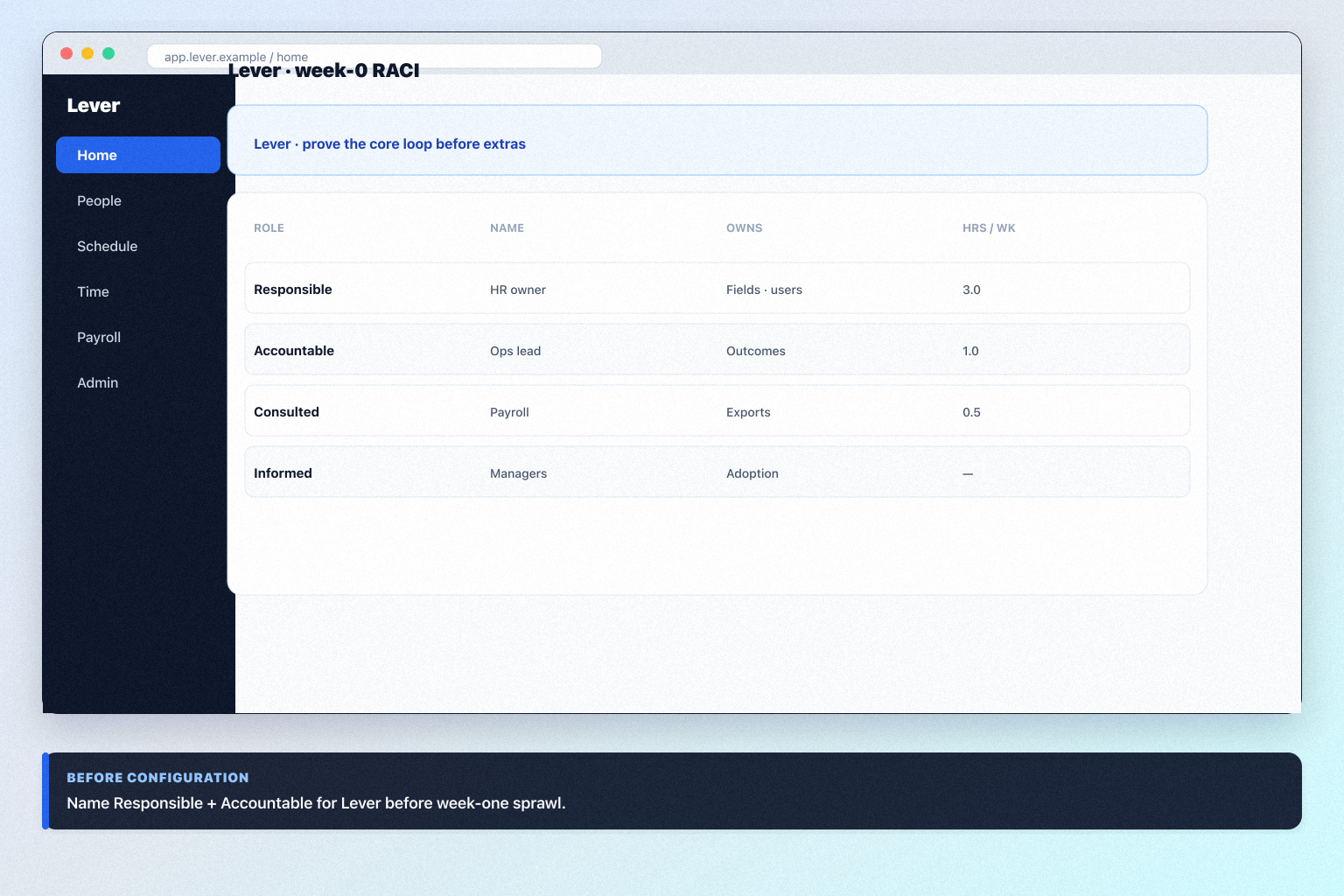
- 2Name an admin ownerFields, users, and hygiene need a responsible party.
- 3Schedule adoption reviewCheck core-loop usage before adding automations.
4. Lock plan gates before phase two
Map must-have workflows to the Lever plan that unlocks them — demos often run above the tier you can afford.
Worked example: Mid-market talent teams that want ATS and recruiting CRM together freezes must-haves on the qualifying tier before adding automations.
5. Measure adoption on the core loop only
Track weekly completion of the primary workflow — not logins alone. If Lever is empty after 30 days, pause new modules and fix the ritual.
Worked example: Mid-market talent teams that want ATS and recruiting CRM together reviews completion rates before enabling AI add-ons.
6. Expand scope only after 90-day proof
AI surfaces on Lever include AI assistant, AI summaries, and AI automation on AI-Powered Hiring Platform and Insights / VONQ / Onboarding. Turn on AI only after the core loop works without it.
Add automations, secondary hubs, or advanced reporting only after the core loop survives a full quarter.
Worked example: Mid-market talent teams that want ATS and recruiting CRM together schedules a 90-day review before buying add-on seats.
7. Lock plan gates before phase two
Map must-have workflows to the Lever plan that unlocks them — demos often run above the tier you can afford.
Worked example: Mid-market talent teams that want ATS and recruiting CRM together freezes must-haves on the qualifying tier before adding automations.
8. Measure adoption on the core loop only
Track weekly completion of the primary workflow — not logins alone. If Lever is empty after 30 days, pause new modules and fix the ritual.
Worked example: Mid-market talent teams that want ATS and recruiting CRM together reviews completion rates before enabling AI add-ons.
9. Expand scope only after 90-day proof
AI surfaces on Lever include AI assistant, AI summaries, and AI automation on AI-Powered Hiring Platform and Insights / VONQ / Onboarding. Turn on AI only after the core loop works without it.
Add automations, secondary hubs, or advanced reporting only after the core loop survives a full quarter.
Worked example: Mid-market talent teams that want ATS and recruiting CRM together schedules a 90-day review before buying add-on seats.
10. Lock plan gates before phase two
Map must-have workflows to the Lever plan that unlocks them — demos often run above the tier you can afford.
Worked example: Mid-market talent teams that want ATS and recruiting CRM together freezes must-haves on the qualifying tier before adding automations.
11. Measure adoption on the core loop only
Track weekly completion of the primary workflow — not logins alone. If Lever is empty after 30 days, pause new modules and fix the ritual.
Worked example: Mid-market talent teams that want ATS and recruiting CRM together reviews completion rates before enabling AI add-ons.
12. Expand scope only after 90-day proof
AI surfaces on Lever include AI assistant, AI summaries, and AI automation on AI-Powered Hiring Platform and Insights / VONQ / Onboarding. Turn on AI only after the core loop works without it.
Add automations, secondary hubs, or advanced reporting only after the core loop survives a full quarter.
Worked example: Mid-market talent teams that want ATS and recruiting CRM together schedules a 90-day review before buying add-on seats.
Frequently asked questions
How long should rollout take?
Ninety days is enough for most SMB/mid teams if you freeze the job and defer extras. Longer programmes help when change management is the risk.
What if we also need a different HR job?
Buy the second job as a second product (or a later wave). Lever should not be stretched into frontline scheduling or a GPS time clock.
Was this article helpful?
Have more questions? Contact our support team.
SoftwareGlimpse Updates
Want clearer software shortlists? Get buying guides and comparisons by email.
Newsletter coming soon.