BigCommerce Implementation: 30/60/90 Store Rollout That Sticks
online storefront; product catalog; checkout payments; order management. Core · online storefront | Growth | Scale. PayPal, Stripe, Amazon. Growing catalog brands comparing open-SaaS TCO to Shopify; Merchants needing multi-storefront or B2B on one platform; Teams with dev resources for API/headless experiments. BigCommerce is a hosted ecommerce platform emphasizing open SaaS — no transaction fee on platform billing when using eligible gateways, multi-storefront options, and API extensibil Buyer question: what must be true before BigCommerce is worth buying versus staying on trial/research? Keep BigCommerce on the shortlist only if Growing catalog brands comparing open-SaaS TCO to Shopify; drop it when Retail-first merchants needing best-in-class POS bundle because 2026 GMV thresholds and open payment provider fees complicate TCO versus headline subscription cannot be patched with more seats.
Quick answer
dropshipping sourcing (Core, Growth, Scale, Performance) decides whether BigCommerce implementation is a one-team pilot or a specialist project — confirm unlocks for dropshipping sourcing (Core, Growth, Scale, Performance) before invites.
- Start with: online storefront
- Gate check: dropshipping sourcing (Core, Growth, Scale, Performance)
- Integrate after: data quality pass on PayPal
BigCommerce rollout rules
- Job cluster first — BigCommerce is hosted SaaS ecommerce platform. Do not implement it as a POS-first Square bundle or a dropshipping importer.
- Adoption before add-ons — If Northline Retail will not open the product weekly, extra apps will not save the rollout.
- Integrations are a phase — Research names PayPal, Stripe, Amazon, and Zapier on the BigCommerce side — confirm the connectors your commerce loop depends on.
- AI is optional — Research lists AI assistant, AI summaries, AI automation, and AI recommendations for BigCommerce. Research places AI assistance on Core, Growth, Scale, and Performance.
BigCommerce 30/60/90
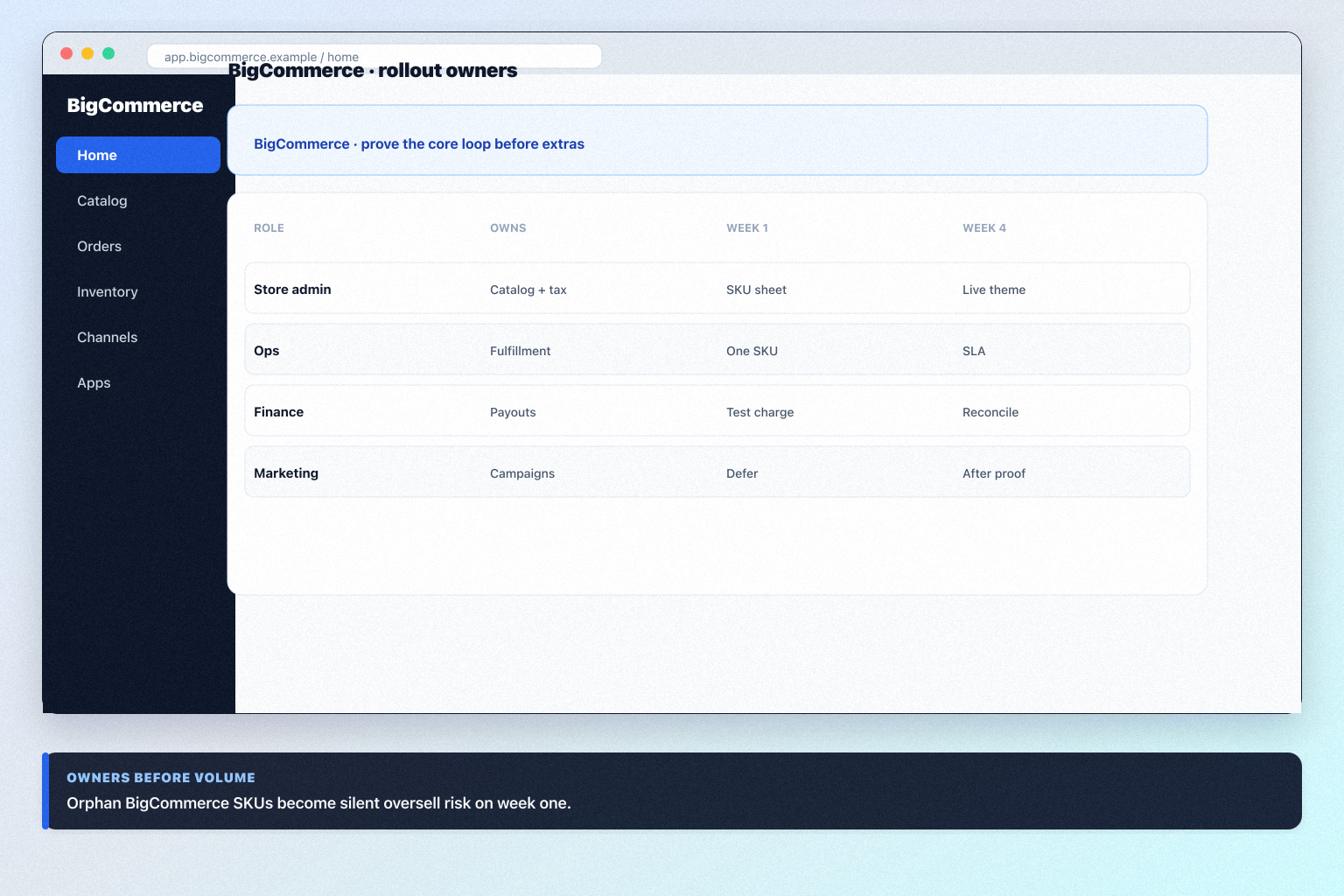
BigCommerce checklist
Bring these questions to every demo
Ask vendors to show the workflow live, not just describe it.
- 1Freeze 90-day outcomesMust-haves for hosted SaaS ecommerce platform before configuration sprawl.
- 2Name an admin ownerFields, users, and hygiene need a responsible party.
- 3Schedule adoption reviewCheck core-loop usage before adding automations.
Frequently asked questions
How long should rollout take?
Ninety days is enough for most SMB/mid teams if you freeze the job and defer extras. Longer programmes help when change management is the risk.
What if we also need a different ecommerce job?
Buy the second job as a second product (or a later wave). BigCommerce should not be stretched into a POS-first Square bundle or a dropshipping importer.
1. BigCommerce day-zero to steady-state sequence
Day zero — objects and owners
Define owners for online storefront, product catalog, checkout payments before inviting the whole org.
SMB pilot
One pipeline / one team proves Growing catalog brands comparing open-SaaS TCO to Shopify before company-wide seats.
Cutover
Freeze legacy writes briefly; validate PayPal and Stripe before reopen.
Treat BigCommerce setup as a controlled rollout — not a weekend dump of CSV files.
BigCommerce implementation go / no-go
BigCommerce implementation mistakes
Mistake 1
2026 GMV thresholds and open payment provider fees complicate TCO versus headline subscription
Mistake 2
Native POS/retail depth trails Shopify/Square for omnichannel-first merchants
Mistake 3
Theme/app ecosystem is smaller than Shopify’s
Mistake 4
Auto-upgrades on GMV can surprise fast-growing stores
Big-bang invite
Inviting every user before object design creates junk data that is expensive to unwind.
BigCommerce plan gates that affect rollout
Implementation fails when unlocks needed for go-live sit on a higher tier than budgeted.
- Seats61%
- Add-ons18%
- Implementation12%
- Training5%
- Other4%
Core
15-day trial · Unlocks: online storefront, product catalog, checkout payments · Suits: teams whose must-have gates appear on this tier
Growth
15-day trial · Suits: teams whose must-have gates appear on this tier
Scale
15-day trial · Suits: teams whose must-have gates appear on this tier
Performance
Contact sales · Suits: teams that need custom procurement
BigCommerce implementation checklist
0/3 dimensions noted — saved in this browser only.
Prep
Pilot
Scale
Was this article helpful?
Have more questions? Contact our support team.
Part of BigCommerce review · Ecommerce hub
Related guides
Supporting reading in this topic — not a generic related-posts dump.
- BigCommerce Migration: Move Catalog & Order Data Without Losing TrustMigrate into BigCommerce with an inventory, field map, pilot import, dual-run week, and validation — so history survives and operators trust the new system.
- BigCommerce Setup: Day-Zero Path to a Working Ecommerce LoopSet up BigCommerce for day-zero work — seats, one core loop, required integrations, and non-admin proof — before optional hubs.
Related products
Related comparisons
SoftwareGlimpse Updates
Want clearer software shortlists? Get buying guides and comparisons by email.
Newsletter coming soon.